Yaesu FTDX10 vs FT-710

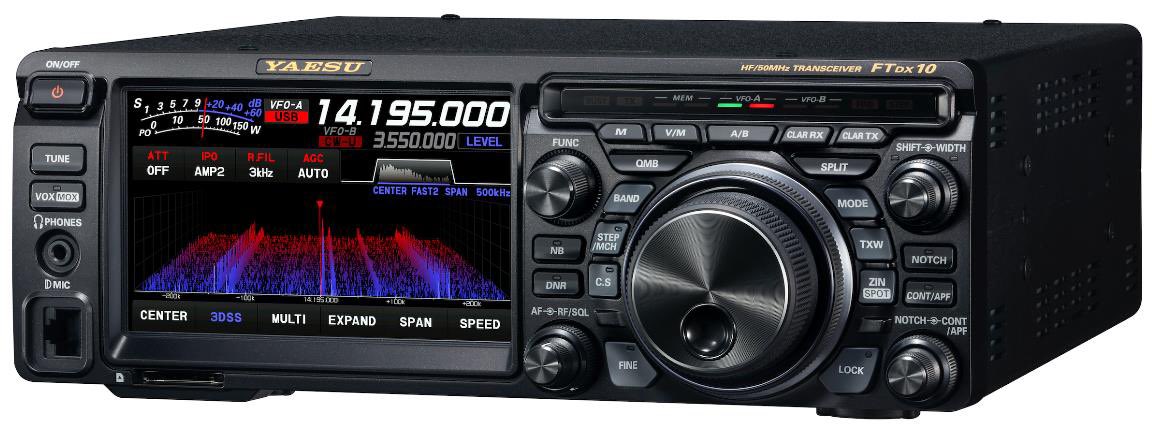
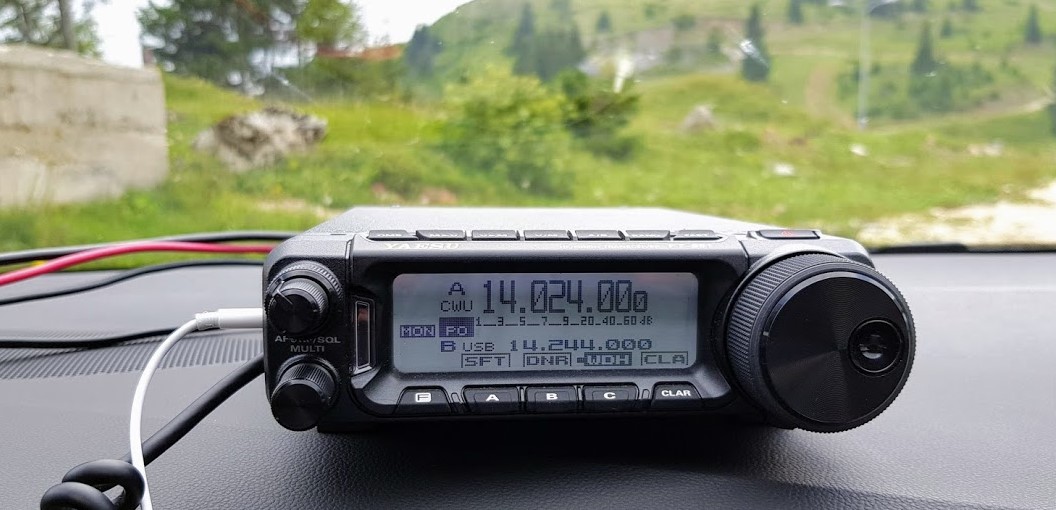
If you’re considering buying either the FTDX10 or FT-710 and wondering what the differences are between these two transceivers, this article offers a user-experience-based comparison. It focuses on how each radio performs in real-life scenarios – what works well, what the pain points are, and what could have been done better.


Receiver Performance

The RX performance of both radios is almost identical. After three weeks of side-by-side testing, I only noticed slightly better CW selectivity on the FTDX10, and even that was marginal despite its roofing filters.

With both radios set to 500Hz bandwidth and identical settings, the difference was barely perceptible when a strong adjacent signal appeared. I found that on the FTDX10, I could approach the signal roughly 40Hz closer before detecting any audio. On SSB, there was no noticeable difference.
 

NB, DNR, DNF

No differences were observed in the operation or effectiveness of NB, DNR, or DNF features between the two radios.
 

Display

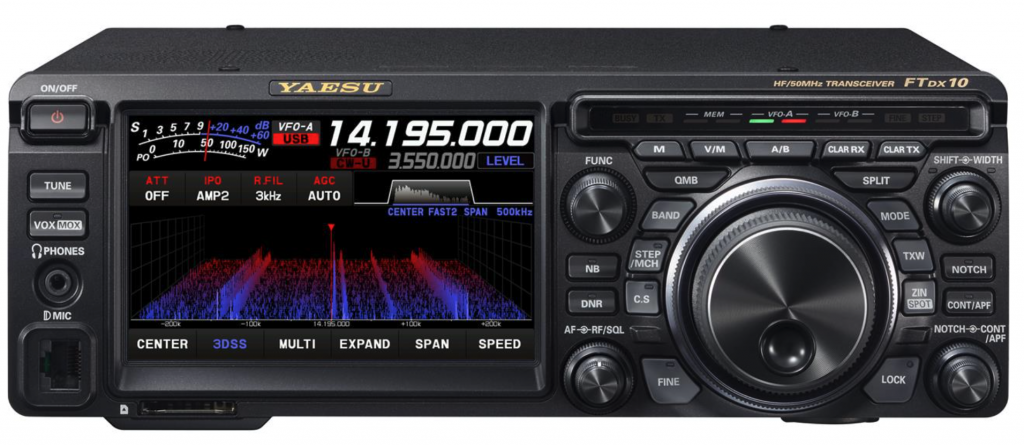
The FTDX10 has a larger and brighter display, although its cooler blue tone can become a bit tiring during night-time operation. By contrast, the FT-710 offers a warmer screen hue that’s easier on the eyes during extended use.
 

Size and Weight

While the numerical differences aren’t dramatic, the FTDX10 is noticeably larger and heavier when the two radios are placed side by side.

FTDX10 dimensions (WHD): 266 x 91 x 263 mm (10.47 x 3.58 x 10.35″); Weight: 5.9 kg (13 lb)

FT-710 dimensions  (WHD): 239 x 80 x 247 mm (9.41 x 3.15 x 9.72″); Weight: 4.5 kg (9.92 lb)
 

AF/RF Knobs

One of my least favourite aspects of the FTDX10 is the placement of the AF/RF knobs—bottom-left of the main VFO dial. With most users being right-handed, this was an odd design choice by Yaesu.

Thankfully, on the FT-710, these controls have been moved to the right of the VFO dial.

However, instead of a dual-function knob, they’ve split AF and RF into separate controls, which wastes valuable front panel real estate. This feels like a regression to the FT-991A logic, rather than a sensible evolution. 
 

VFO Outer Dial vs STEP/MCH

I prefer the FT-710’s approach to fast tuning via the STEP/MCH dial. It allows for configurable step sizes (1–20 kHz per notch) and works quite well – similar to what Kenwood radios offer.

However, the outer VFO dial (MPVD) on the FTDX10 allows you to control the Clarifier and assign it a custom function (via the C.S. key). I personally use it to adjust the Level setting, while the FUNC knob adjusts CW speed.
 

Clarifier

The FTDX10’s implementation is significantly better. It features separate keys for CLAR TX and CLAR RX, both controlled via the outer VFO dial—simple and effective.

The FT-710 opts for a minimalist approach that, in my view, misses the mark. A single Clarifier key cycles between RX, TX, and RX+TX modes, and you need to press it three times to turn it off.

Clarifier controlled by the main VFO dial, so you must disable Clarifier before you can tune the frequency again. 
 

Custom Function (C.S.)

This is a great feature on the FTDX10 and unfortunately absent on the FT-710. The C.S. button lets you assign one of 16 functions (e.g. Level, Peak, Contrast, Dimmer, M-Group, Mic Gain, etc.). A real convenience that FT-710 misses out on.
 

Shift / Width / Notch / Contour / APF

The FTDX10 has dedicated knobs for all these key functions. On the FT-710, they’re buried in the DSP menu (accessed by pressing the STEP/MCH knob).

While Shift, Width and Notch are manageable this way, using Contour and especially APF is far less intuitive and quite frustrating.
 

NAR Key

Adjusting bandwidth on the FTDX10 is simple – you just turn the dedicated knob. You can also select a roofing filter via the touchscreen and then adjust via the same knob. On the FT-710, it requires navigating the DSP menu, which is clunky.

That said, the FT-710 redeems itself slightly with a dedicated NAR key, configurable in the menu. For instance, you could set the NAR width to 350Hz for CW, and use 800Hz in the DSP menu for tuning. One button press takes you to the narrower filter, a nice, old-school-style feature.
 

Meter

Both radios have nearly identical meters, with one major difference: the FTDX10 displays peak power, while the FT-710 can be configured for either peak or average. Sounds great—until you realise that in peak mode, the FT-710’s meter permanently engages peak-hold with no option to disable it. The result is a very choppy and unpleasant display experience.
 

Front Panel Layout

Neither radio excels in front panel ergonomics. The FTDX10 has buttons crammed tightly between knobs and the VFO, far from ideal.

The FT-710 looks cleaner but makes questionable choices. Separating the AF and RF knobs is unnecessary, and the single Clarifier key is awkward. Some keys, like MODE, could easily be screen-based. Even BAND selection could have been moved to the screen, but wasn’t.


A better layout would have combined the AF/RF knobs to free space for a dedicated Clarifier control.
 

Pop-Up Selection Panels

The FTDX10 is notoriously inconsistent in pop-up selection panel timing. For details, see my FTDX10 deep dive review.

The FT-710 also has inconsistencies, but offers menu settings to control the timing (Slow, Medium, Fast), which helps a bit.
 

Using an Amplifier

The FTDX10 allows simultaneous use of an amplifier and the FH-2 keypad. The FT-710 does not.

If your amplifier requires an ALC connection, this must go into the REMOTE jack – rendering the FH-2 unusable at the same time.
 

Conclusion

While the FTDX10 and FT-710 share similar core performance, their differences lie in usability, ergonomics, and feature accessibility.

The FTDX10 offers more intuitive controls, better Clarifier handling, and useful customisation options like the C.S. key.

The FT-710, on the other hand, has a cleaner look, a more compact design, and some practical enhancements like the configurable NAR key.

Ultimately, choosing between the two comes down to your operating style and which compromises you’re willing to make in daily use.


Yaesu FTDX10 in CW contest

Earlier this month I decided to put my IC-7610 aside and give the FTDX10 a good go in a contest. It was Oceania DX Contest and I opted to run SO 20m HP category. 24 hours of CW madness.

Conditions were excellent, but not as good as in SSB leg a week earlier.

One thing I love about this radio is how good its receiver is. The roofing filters did a great job, 300 Hz is amazing, albeit a bit too narrow for contest when running CQ. Too many stations tend to be off-beat a bit and the 500-600 Hz width works best for me.

I was able to hear weak stations quite easily right next to big ones and only once I had to ask someone to QSY as the station came too close, within 100 Hz of my frequency.

Talking about the off-beat stations, I had to use the Clarifier (RIT) quite a bit to pick them. I never liked the way the RIT is implemented on this radio. The CLAR RX and TX buttons are in the right place, but using the MPVD ring (multi purpose VFO outer dial) is not a good idea. A few times in contest the CLAR RX was off and moving the MPVD moved me way off my frequency. Very frustrating.
Read More

Yaesu FTDX10 deep-dive review

I purchased Yaesu FTDX10 in early 2021 after having read many reviews and watched every video on Youtube that I could find.

The radio was beautiful, the right size, right weight, exactly what I was after. It had a big, crisp and bright touch screen and looked amazing on my desk.

I put my IC-7610 aside and set the FTDX10 as my primary radio, just for enough time to learn to really appreciate the latest Yaesu technology and to learn to love this radio.

Over the following 10 months I kept swapping it with my IC-7610, using both of them for about the same amount of time. I had an IC-7300 previously, but sold it in order to upgrade to IC-7610. However, I had access to a friend’s IC-7300 so I put it alongside the FTDX10 to be able to compare them.

I am a strong believer of product usability and I am expecting a product to perform to its specifications, to have high reliability and that the usability of the product is not flawed. By this I mean the product should do things in a simple, unobtrusive and logical way, not requiring the user to go out of his way to achieve something.

This review is written from that point of view – the radio usability and reliability.

Read More

Yaesu FTDX10 firmware mess

Read a related article – 5 Jan 2022 – Yaesu FTDX10 deep-dive review

In early April 2021 Yaesu issued a new firmware version 1.05 to address a few issues in V 1.04. This update turned out to be quite a disaster for some hams causing their radio all sorts of problems. Yaesu were quick to address this and released version 1.06 a few days later.

It turns out that the version 1.06 is more of a downgrade than upgrade over 1.04, and this is why.


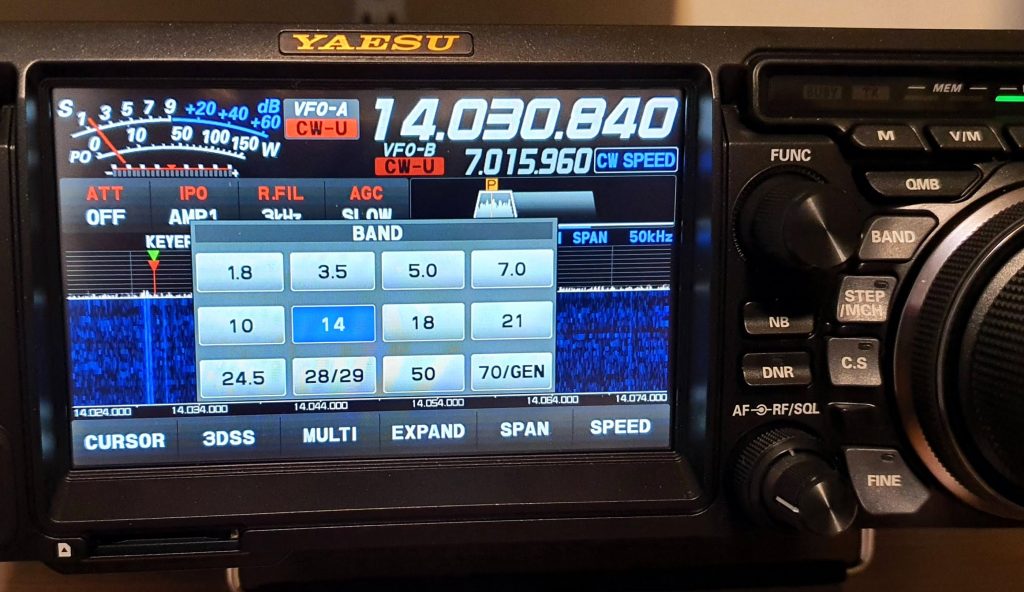
Band selection

In V1.04 you could change the band by pressing the BAND key and selecting the band on the touch panel. You could also press the BAND key, turn the MPVD ring (multi purpose VFO outer dial) to the desired band then press the FUNC knob and your radio changes the band. Both of these functions still work in V1.06.

However, in V1.04 you could press the BAND key, turn the MPVD ring to the desired band and after 2 seconds the radio changes the band. This has been removed in V1.06.

Interestingly the same functionality for MODE selection has survived the cull and is still available in V1.06.

(Update: the MPVD band change functionality has been restored in V1.08 in May 2021)

Read More

Russell Island OC-137 – November 2020

After a not so successful operation from Russell Island in 2018, I decided to go back this year and have another go. I booked the same place from Thursday 19th to Tuesday the 24th November.

This time I brought two different antennas and some spare coax, some wire and a 8m squid pole, just in case.

I had the trusted multiband vertical (Hustler 6BTV) and an end-fed half wave (MyAntennas EFHW 8010).

Last time I had my vertical antenna in the middle of the backyard, about 5m from the water, but this time I decided to go to the edge, fully knowing that the ocean tide will affect the SWR.

Read More

Icom IC-7610 review

After quite some time trying to decide between FTDX101D and IC-7610, I finally opted for the Icom. The radio has arrived and now that I had a chance to use it for a couple of weeks I must admit that I am quite impressed. I live in a very noisy suburban environment, but this receiver is incredibly quiet comparing to any radio I had before.

The noise blanker is spectacular. On 40m I have some power line noise that I was unable to find the sorce of so far, but the IC-7610 wipes it off just like that. Most importantly, it does it already at about 10% (level 10), while IC7300 needed to go to 80% and still not completely kill it off. The signal distortion at NR level 80 on IC-7300 is pretty bad..

The display is simply gorgeous. Many have written reviews and posted various videos about beauty of this display and all I can do is comletely agree. It’s perfect.

The ergonomics – also top notch, with maybe one or two very minor objections. I wish there was a MODE button that flips between CW and SSB, while other modes are selected by touchscreen. The other thing is that I still go for the SUB AF/RF gain knob almost every time, because it just feels natural for AF/RF Gain to be there. Because this radio has two receivers, the main receiver AF/RF Gain control is further up. It’a matter of getting used to, I guess.

Yaesu has done something funny on FTDX101D, they put the main receiver knobs and buttons on the bottom and the sub receiver stuff above it. It looks weird but it seems to be working better, at least it would for me.

APF on CW is heaven. In the current conditions where we can barely hear anyone here in Australia, picking up that tiny signal amongst all the local QRM is quite a task and APF comes to shine here. APF on FTDX3000 was great, but this one is better.

The problem with the universally hated (or loved) elec-key plug on the front of the radio is easily solved by using an L-shaped adapter from eBay, best spent $2.


Now, all we need is for the sun to wake up and give us some joy on the bands.


Operating as E7/VK4DX from Bosnia

What a difference a continent makes! 🙂


I lived in Australia for the past 21 years and have gotten used to almost everything I hear being a DX, usually 8,000km or more away from here. Having finally operated from Europe again it reminded me that the world of HF looks very, very different from there.

We go to Europe to visit our family and friends every one or two years and this time I have decided to take my radio and a linked dipole with me. The best thing I’ve done in a long time.

With conditions being awful here in VK and almost nothing to work on HF, I was curious as to what I will be able to hear and work from Bosnia.

The first experience was very surprising. I’ve hanged the linked dipole in my mother-in-law’s backyard, one end off the cherry tree about 5m high with the other end going down to another tree just about 2m above the ground. The antenna was right next to the wall almost touching it and had quite a few other houses within meters from it.

This small town (Vogošća) is surrounded with hills ranging from 500 – 800+ m asl, so the location was pretty much terrible.

I hooked the radio to the battery and operated from the car parked in the front yard.

A short CQ on 20m SSB and not long after that I had 30-ish stations in the log.

Over the next couple of weeks I operated portable or mobile from several places and activated three WWFF areas and one SOTA summit.

The experience was unbelievable.

In Australia, if I go out to activate a park I usually operate for 2-3 hours, sometimes even longer, in order to get 44 QSOs in the log. Sometimes I get to the magical number, but sometimes there’s just not enough stations on the band and I end up short. These are almost always only SSB QSOs. If I make 5-6 CW QSOs that’s a big bonus.

From Bosnia, it takes 15-20 minutes to get 44 QSOs in log. The activity is just not possible to compare, hundreds of stations for one in VK. CW to SSB ratio seems to be around 50:50 as well.

From Jahorina (E7FF-0015) I logged about 250 QSOs in 3 hours. The funny thing is that the antenna was 300m above ground. Well, not really, it was stretched between two trees, but if you walk just a few metres from these trees to the north, the ground drops 300m almost instantly. The location I operated from was about 1,900m asl. Most of the reports were “Man, you’ve got a big, big signal here.

My operating position on Trebevic (E7FF-0006) was also very high, some 1,600m asl, but I had to cut the operation short after about two hours and 200 QSOs as I found myself in the middle of a really bad storm, with lightning strikes just a few hundred meters away.

My last activity from Bosnia was from Bijambare (E7FF-0027), I logged 385 QSOs in just under 3 hours of on-air time, all on 40 and 20m, both SSB and CW.

I was quite lucky to operate from there in the first place. A day before I visited the park  with my wife to see the caves.

On the way out I spoke to the security guard who got me in touch with the park manager and after a few calls between him and the state manager for national parks I was given permission to enter the park with my car and operate from a certain spot hidden from visitors.

I wasn’t aware of this, but the Bosnian regional manager E77O later advised that this was a first operation from Bijambare, a new one for everyone – yay!

Here is a video of a few minutes on air from there.

The park is absolutely amazing. If you ever go to Bosnia and don’t visit Bijambare, you’re just … a little bit more than crazy.

Unfortunately, neither of these three parks counted for SOTA as I was operating from the car or was connected directly to the battery in the car, and I was tiny bit short of the -25m summit area.

However, the Hum (E7/BO-066) was a complete SOTA job, operating from the very top and using an old car battery that I had to carry (and almost breaking my back) for the last few hundred meters … and back to the car. It’s incredible what 20w with a low dipole can do when used at high altitude.

I’m back home in Australia now and have finalised all logs. All QSOs from the paper notebook have now been entered into the computer log and submitted to WWFF and SOTA online logs. I will be printing QSLs shortly, so for those of you who would like to have the QSO confirmed on paper – it’s coming soon.

The log will be uploaded to the ClubLog soon as well.

Taking the radio gear with me was a last minute decision, so operating from Bosnia was pretty much unplanned and completely disorganised. For next time (likely in 2020) I’ll have some schedule and definitely have my laptop for logging, entering over 2000 QSOs in the computer log was a real pain.

Thanks everyone for the QSOs, your patience and endless fun. See you in 2020 from E7 and in the meantime from some other places closer to VK.

Russell Island – OC137

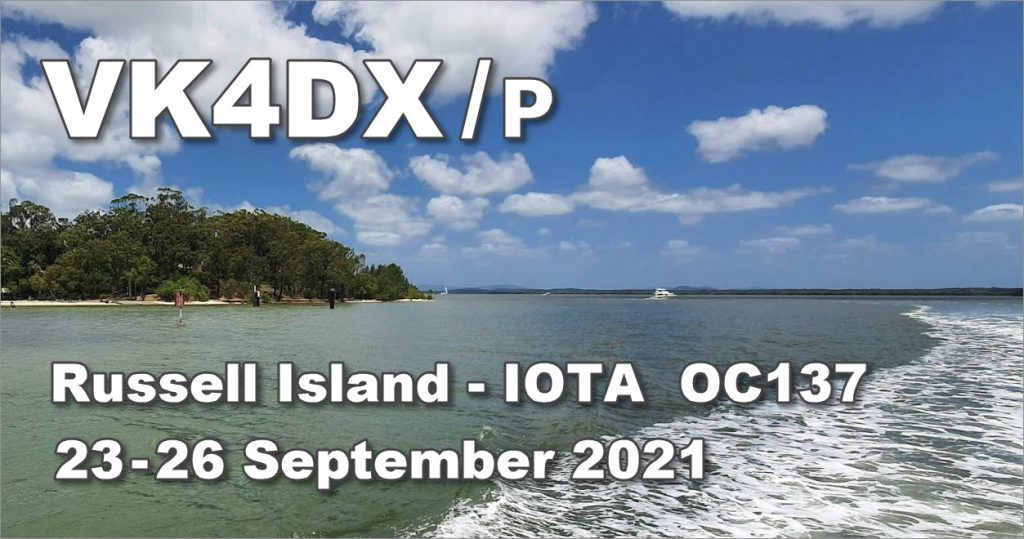
This past weekend I was QRV from Russell Island. The island is part of the Queensland State (South Coast) South group – IOTA OC137.

Unlike previous one-day operations from Coochiemudlo Island, this was a weekend long operation, and I was accompanied by my wife and our daughter. The accommodation was amazing, we rented a small cottage right at the water-front with a view to another island, the largest one in the group – North Stradbroke Island.

We arrived around midday on Friday and unpacking, having the lunch, setting up the radio and antennas took some time but I was on the air around 4pm.

There were some issues with the antenna as I couldn’t get the SWR anywhere in the acceptable area on either 40 or 30m. Pulling the 30m trap apart showed some rust and cleaning it up fixed the things quite nicely.

With the antenna (Hustler 6BTV) all tuned up it was time to get on the air.

Conditions were, ummmmm … challenging. The noise was much higher than expected it would be and the signals were just not strong enough. JA stations on 40 and 30m were in the S5-6 region at best. Normally most of JAs are always over S9.

At times I would call for 20 minutes with no replies. At some point I scanned 40, 30 and 20m and all I could hear were a few VK and ZL stations on SSB, nothing else.

As if this wasn’t bad enough, with the first darkness something kicked-in in the neighbourhood giving me a solid S7 static across all bands. NB didn’t help at all, it was a solid, thick and very mean noise.

That night I ended up going to bed relatively early, just before midnight and I was up just before the sunrise on Saturday.

The noise was still there but faded pretty quickly as the sun showed-up.

Twenty metres opened up quite nicely for about two hours and I even had to work split as the pile up from Japan was unmanageable on the same frequency.

Most of the day on Saturday I spent with my family driving around and exploring the island, and in the afternoon I was back on air around 3pm.

I had emails from a few hams asking for a contact at certain time and band, but the conditions were so unpredictable that it was hard to be sure it would work. In the end we made it in most cases.

That night the noise was much lower, so I could make some decent runs on 40 and 30m, and then on 20 in the morning again. Having put up a 40m dipole earlier on Saturday turned out to be a good idea as dipole isn’t as noisy as the vertical antenna. FTDX3000 makes it very easy to use receiving antenna, so this was a great help.

We had to check out by 11 am on Sunday and get to the 12 o’clock barge back to the main land.

It was fun and I’m hoping that in few weeks time I’ll do another weekend trip to one of the OC137 islands.

IOTA OC137 – Coochiemudlo Island

Today I made a day trip to Coochiemudlo Island (IOTA OC137) with my wife and daughter and I thought I’d take my portable radio setup with me and “see how it goes”.

20180425_164448.jpg

Well, it went pretty good and I’ll definitely be back this weekend, weather permitting.

I operated form the park, just about 30m from the beach, but considering I used battery power I could only run low power (20watts).

20180425_155257.jpg

I used Yaesu FT-891 with 4200mA/h LiFePO battery. The antenna was a 40/20/15 m linked dipole, set up as an inverted-v, hanging off a 7m long squid pole.

We stayed in the park for about two hours and I logged approximately 80 QSOs, mostly JA and UA0 stations, all 20m CW.

Coochiemudlo is a tiny island just off the coast of southeast Queensland, near Victoria Point in Brisbane. It belongs to the Queensland State (South Coast) South group – IOTA OC137.

Please like/follow the VK4DX Facebook Page for more information and announcements of future operations.

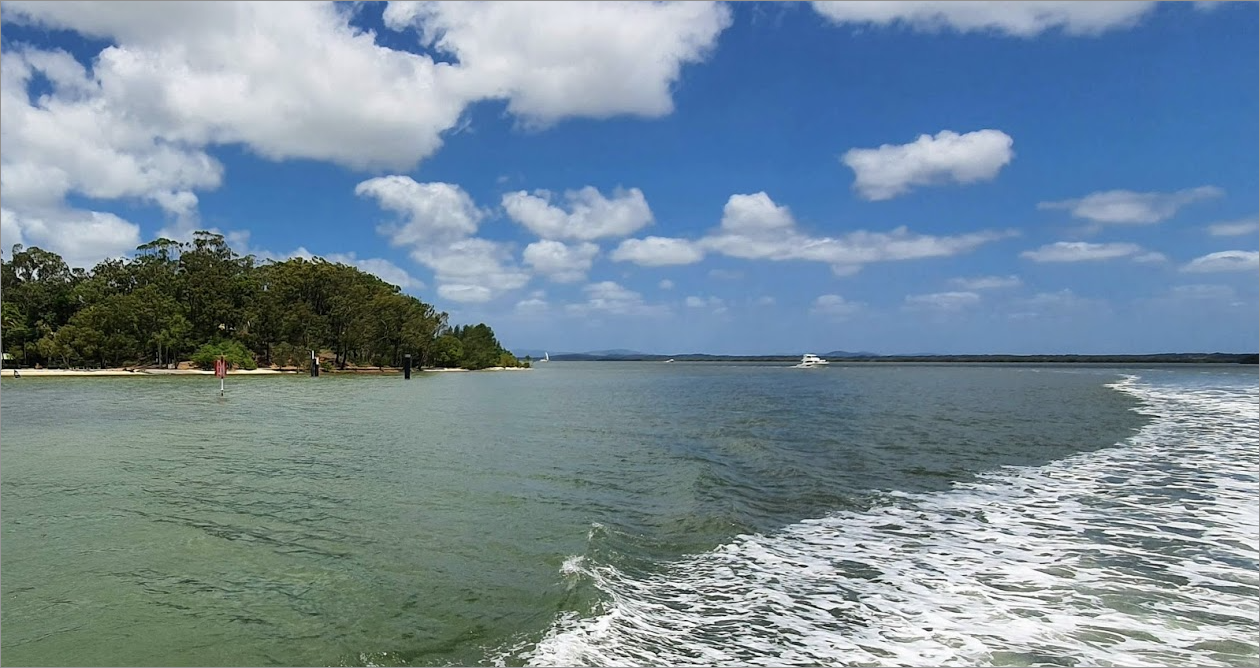
Below are a few photos of me operating and of the island itself as taken from the ferry.

20180425_152944(0)

20180425_152932

20180425_164415.jpg

20180425_144217.jpg